
Blog
Revitalign vs Vionic: Which Supportive Shoe Brand Fits You Better?
If you are comparing Revitalign vs Vionic, both focus on supportive footwear but feel different. Revitalign leans into biomechanical alignment and structured footbeds, while Vionic combines arch support with lifestyle versatility for walking, travel, work, and dressier use.
Revitalign vs Vionic: Which Offers Better Arch Support and Stability?
Both can work as arch support shoes.
Revitalign emphasizes foot alignment through PWR-BRIDGE, supportive heel geometry, and full-contact designs. Meanwhile, Vionic uses VioMotion in models such as Walk Max Skyline to pair arch support and stability with cushioning. For podiatrist-recommended footwear, plantar fasciitis shoes, walking shoes, or orthotic insoles, your foot shape and the exact model matter most.

Revitalign vs Vionic for Arch Support and Foot Alignment
Revitalign is owned by Waco Shoe Company and uses PWR-BRIDGE to support the heel and midfoot while distributing load across the foot.
Revitalign Gaia has a full-contact footbed that increases underfoot contact, forefoot cushioning to soften impact, a deep heel cup for heel stability, and anatomically designed arch support. The result is a distinctly alignment-focused setup.
Active Alignment Orthotics were developed with Heeluxe Research Lab and accepted by the American Podiatric Medical Association for promoting foot health. They come in XS to L, fit about EU 35–42, and use a 360-degree heel cup to stabilize the rearfoot.
Antimicrobial EVA cushions the foot, recycled cork supports the footbed structure and contributes to shock absorption, while recycled jersey top cloth reduces friction and heat buildup.
That makes the Revitalign orthotic insole useful for upgrading an otherwise unsupportive shoe. In practical terms, its supportive arch assists foot alignment while the heel cradle adds rearfoot stability rather than relying only on soft cushioning.
Revitalign vs Vionic for Cushioning and Walking
Vionic Walk Max Skyline combines Super Critical foam with VioMotion technology for shock absorption, arch support, and stability. Walk Slim Glide targets travel and long-distance walking, where a cushioned midsole, breathable construction, roomy toe box, and stable support can reduce pressure and blister risk.
Vionic also spreads support into dressier styles. Calera Wedge has built-in arch support and a rear strap that improves wedge stability, while Kimmie Slip-On uses a thick, resilient outsole with cushioned arch support. The Vionic range includes sneakers, wedges, flats, loafers, and sandals.
Comfort, Fit, and All-Day Wear
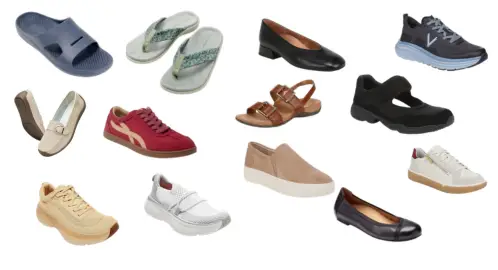
Revitalign’s range includes slides, flip-flops, loafers, and sneakers. Azalea is positioned as supportive enough for all-day everyday wear, while Belmont Stripe combines a cushioned insole, arch support, and collar padding. Together, those models reinforce Revitalign’s combination of comfort and biomechanical foot support.
Vionic feedback is more model-specific. Many users describe sturdy sandals or slippers but less supportive athletic shoes, while removable insoles in some closed shoes allow orthotic replacement. A roomy toe box, correct width, secure heel hold, and suitable arch shape can matter more than the logo because personal fit determines practical comfort.
Revitalign Advantages and Disadvantages
- Advantages: alignment focus, deep heel cups, full-contact footbeds, anatomical arch support, dedicated orthotics, and strong shock absorption.
- Disadvantages: structured support can feel more noticeable than neutral cushioning, and proper sizing still matters.
Vionic Advantages and Disadvantages
- Advantages: broad lifestyle selection, VioMotion support, cushioned walking models, removable insoles in some shoes, and options from sneakers to wedges.
- Disadvantages: support and sizing can vary between models, so online buying may involve trial and error.
Revitalign vs Vionic for Plantar Fasciitis, Flat Feet, and High Arches
Supportive footwear may improve plantar fasciitis comfort by controlling the heel, supporting the arch, and cushioning impact, but shoes are not a guaranteed treatment.
Revitalign Active Alignment Orthotics are marketed for plantar fasciitis, flat feet, high arches, and Achilles-related discomfort. Their contoured biomechanical support, 360-degree heel cradle, antimicrobial EVA, and recycled cork are designed around cushioning and rearfoot control.
Vionic can also suit people seeking strong arch support in everyday footwear. A walking sneaker benefits from a roomy toe box, while a removable insole may allow a personal orthotic.
Since users report that Vionic fit and support differ across models, you should judge the specific shoe rather than assuming every Vionic has the same footbed.
Which Brand Should You Choose?
Choose Revitalign when you want pronounced biomechanical support, a deep heel cup, full-contact support, or an integrated PWR-BRIDGE alignment system. Gaia, Azalea, Belmont, and Active Alignment Orthotics all reinforce that structured approach.
Choose Vionic when you want support across a broader lifestyle wardrobe or prefer VioMotion, resilient outsoles, breathable uppers, and cushioned midsoles. Walk Max Skyline, Walk Slim Glide, Kimmie, and Calera show how Vionic adapts support to several shoe types.

With either brand, the best shoe depends on your arch, toe-box needs, heel shape, and daily activity.
FAQ
1. Is Revitalign better than Vionic for plantar fasciitis?
Not universally. Revitalign offers PWR-BRIDGE, deep heel cups, and dedicated orthotics, while Vionic offers VioMotion and built-in arch support. Individual fit, symptoms, intended activity, and professional advice should guide the choice.
2. Does Vionic have stronger arch support than Revitalign?
It depends on the model. Vionic Walk Max Skyline uses VioMotion for arch support and stability, while Revitalign Gaia combines anatomical arch support with a full-contact footbed and deep heel cup. Their support can therefore feel quite different.
3. Do Revitalign and Vionic fit true to size?
There is no universal answer. Footkaki notes that sizing and width vary by manufacturer and design, while some users report model-to-model Vionic sizing differences. Trying the exact shoe or choosing a retailer with a flexible exchange policy is sensible.
4. Can I use orthotic insoles with Revitalign or Vionic shoes?
Yes, if the shoe has enough internal depth and a removable factory insole. Revitalign also offers Active Alignment Orthotics, while some Vionic closed shoes use removable insoles that can allow orthotic replacement.
Closing Words
Revitalign vs Vionic is less about one universal winner and more about your preferred support feel. Compare the exact model, check fit carefully, and tell us whether you prioritize alignment, cushioning, plantar fasciitis support, or everyday style.